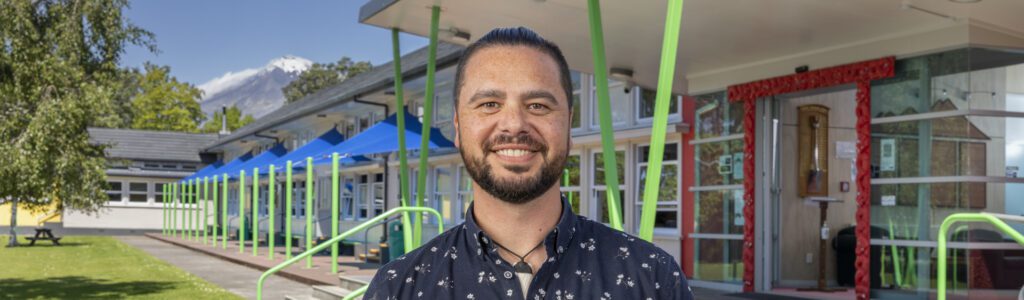
“If you love working with young people and educating, then this is such a fulfilling role. My advice to all young people is believe in yourself and your capability to learn. Your ability to work with other people and maintain mutually respectful relationships is more necessary than your intelligence.”
– Scott Walden, Principal
About this career
Excellent school leaders are what is needed to ensure a high-quality education system in a rapidly changing world.
School leaders can help to effect change and create the kind of education system that will enable Māori to thrive!
The role of a School Principal comes with many rewards and challenges. Principals need to be ethical leaders.
Their main role is to facilitate the school so that teachers can help tauira become successful learners, confident and creative individuals, and active and informed citizens.
A School Principal effectively engages people and leads the school across all systems including finance, property and personnel, to support and enhance student learning, and to ensure the future of the school’s development.
School principals need to be visible, approachable, excellent communicators with the capability to develop strong relationships within and throughout the school and community.
Principals need to be great collaborators – they need to be able to empower staff and others involved in the school community to create environments that encourage happy, confident learning to take place.
The role requires a genuine commitment to working in partnership with parents, whānau, staff and the local community to create a place of learning where everyone is welcome and safe; where everyone’s culture and contribution is acknowledged, valued and celebrated.
It is very important that the principal gives effect to Te Tiriti o Waitangi in the context of local environment and curriculum.
School Principals must maintain a comprehensive and deep knowledge of effective learning and teaching and have strategic thinking capability with the school team and community to create the future pathway to achieve the school’s goals.
Personal qualities you need
- Excellent communication and leadership skills
- Exceptional care for young people and whānau
- Honesty and integrity, emotional and social intelligence
- Passion for learning, teaching and knowledge sharing
- Ability to inspire a sense of purpose and meaning
- Ability to bring people together and to engage others into action
- Excellent problem solving, able to navigate change and complexity
Career Pathway
There are various pathways to becoming a school principal. The most common one being starting career as a teacher, developing your leadership and management experience and seeking deputy principal opportunities prior to applying for principal positions. It is possible to do post-graduate study to assist you to develop relevant knowledge and skills.
Find out more about Principal careers:
Principals and schools | Education Workforce
https://www.educationalleaders.govt.nz/Leadership-qualities/Reflecting-on-leadership/Becoming-a-principal-and-making-a-difference
Post-graduate Diploma in Secondary School Leadership – https://www.careers.govt.nz/qualifications/view/VI001C/7004
Our Whānau Career Story
Scott Walden – Principal, Māori Education Leader and Advocate
Ko Taranaki te maunga
Ko Whaitara, ko Pungaerere ngā awa
Ko Tokomaru, ko Kurahaupo ngā waka
Ko Te Ātiawa, ko Ngāti Mutunga, Ko Taranaki ngā iwi
Ko Pukerangiora, ko Ngati Haupoto, Ko Ngāti Tairi ngā hapū
Ko Kairau, ko Te Potaka, Ko Ōākura ngā marae
Kei Ngāmotu ahau e noho ana
Ko Te Mokena rāua ko Te Ihorangi āku tama
Ko au te Tumuaki ki te Kura Hāpori o Marfell
Ko Scott Walden ahau
Where do I work and what do I do?
I am the Principal of Marfell Community School, a Year 0–6 primary school in New Plymouth, Taranaki. Our kura provides three educational pathways: English-medium mainstream education, our Level 2 Māori immersion pathway, Āwhinatia i te Reo, and Whare Manaaki, our high and special needs learning provision.
As principal, my role is varied and rewarding. I lead teaching and learning, support and develop staff, manage finances and property, and work alongside our whānau, iwi and wider community to create the best possible opportunities for our tamariki.
Beyond my kura, I am actively involved in educational leadership and advocacy. I am Co-President of the New Plymouth Principals Association, an Executive Member of the New Zealand Principals Federation, and a Regional Facilitator with the Māori Achievement Collaborative (MAC). I am also a board member of Te Arahou Aotearoa, supporting professional learning that strengthens culturally sustaining practice and Māori success as Māori.
At the heart of all these roles is a shared purpose: improving education so every learner has the opportunity to succeed, belong and reach their potential.
My Career Pathway – From the classroom to Principalship
My journey into education wasn’t a straight line, and it certainly wasn’t all mapped out from the beginning.
After completing my secondary schooling at Nelson College, I worked as a labourer for my uncle’s construction business. That experience encouraged me to think more seriously about my interest in teaching and the possibility of a career in education.
I was accepted into Te Rangakura, a three-year, work-based primary bilingual teacher-training programme delivered through Rangahāua in Whanganui. I was placed at Takaro School in Palmerston North, where I learned on the job while completing my training.
By the age of 19, during my final year, I was teaching a class of 38 Year 4 and 5 students under a Limited Authority to Teach. I graduated in 2000 and continued teaching at Takaro for another two years.
My kuia, Roberta Walden, had other ideas about where my future lay. She regularly sent newspaper clippings advertising teaching vacancies back home in Taranaki. When I failed to take the hint, she took matters into her own hands and arranged an interview with John Niwa, the principal of Manukorihi Intermediate School in Waitara. That opportunity brought me home and began the next chapter of my career.
In 2007, I completed my Bachelor of Education at Massey University before returning to the classroom at Waitara East School. Having worked predominantly in Māori immersion education, I became the senior teacher of a Level 2 Māori immersion unit and an Assistant Principal. These roles strengthened my understanding of educational leadership and the importance of creating learning environments where Māori identity, language and culture are valued.
In 2012, I was appointed Principal of Manukorihi Intermediate School. After five and a half years leading learning and change there, I was ready for another challenge. I successfully applied for the principalship at Coastal Taranaki School, an area school that offered the opportunity to extend my leadership experience into secondary education.
My two sons were young at the time, and both of my nans joined my whānau, friends and colleagues at my pōwhiri. It was a special occasion, marking my return to the wider area where I was born and where much of my whānau have their roots.
After several rewarding years on the Coast, I returned to a primary school leadership role at Marfell Community School in New Plymouth in 2025. During this time, I also served as the Regional Facilitator for the Māori Achievement Collaborative (MAC). Today, with 26 years in education and 14 years as a principal, I continue to learn, grow and advocate for better outcomes for tamariki and whānau.
“My why” for doing this job and making a difference for Māori
My commitment to Māori education is deeply personal. It comes from my own experiences as a learner and from witnessing the experiences of other Māori students throughout my schooling.
I vividly remember a day at primary school when a relieving teacher organised a game and divided the class into Māori and Pākehā teams. She then turned to me and said I could choose which team I wanted to join because I was a ‘half-caste’.
That evening, I asked my family about the term. Their response was clear: I was Māori.
That moment stayed with me. It prompted me to think more deeply about identity, belonging and how Māori are seen and treated within the education system and wider society.
Those questions became even more significant during my secondary school years. I was part of a whānau class made up largely of Māori boys. By the age of 16, many had already left school. By the end of Year 13, I was the only one remaining from my original group.
I couldn’t ignore what I was seeing. I campaigned against school practices that involved confiscating taonga, raised funds and organised wānanga for Māori youth at risk, and tutored kapa haka at two primary schools.
Even then, I understood that education needed to be about more than academic achievement. It needed to recognise identity, build belonging and create opportunities for young people to see a future for themselves.
Throughout my teaching and leadership career, I have continued to work alongside Māori learners and their whānau. I have seen the difference that culturally responsive teaching, meaningful relationships, and learning grounded in identity, language and culture can make.
For me, Māori success as Māori means ensuring our young people do not have to leave their identity at the school gate to succeed. They should be able to bring their whole selves into their learning and have their culture, whakapapa and aspirations recognised as strengths.
Creating opportunities for the next generation
In my current role, I am committed to building a school where every learner belongs and has opportunities to thrive.
This includes strengthening te reo Māori and tikanga across our kura, supporting staff to grow their confidence in culturally sustaining practice, and ensuring our curriculum reflects the histories, stories and knowledge of our local iwi and hapū.
Through my involvement with the Māori Achievement Collaborative, I work alongside educational leaders from across Aotearoa to challenge thinking, influence practice and improve outcomes for Māori learners. Our shared kaupapa is to shift hearts and minds so that Māori success as Māori becomes an expectation throughout our education system, rather than an aspiration.
I am also involved in initiatives that connect learning to the wider world, including environmental education partnerships with neighbouring schools, iwi, hapū and community organisations. These opportunities help young people understand their place in the world and recognise that they can contribute to meaningful change in their own communities.
I believe education works best when schools, whānau and communities work together. Young people need opportunities to discover their strengths, explore different pathways and connect their learning with a future that matters to them.
That is also why the work of organisations such as WhyORA is important. Supporting taiohi to navigate education, wellbeing and career pathways can open doors that young people may not have realised were available to them.
My advice to young people
Looking back over my journey, I know that success isn’t about having everything figured out from the beginning. My pathway has included unexpected opportunities, people who believed in me, and challenges that helped me grow.
My advice to young people is simple: believe in yourself and your ability to learn. You don’t need to know exactly where you’re heading, but you do need to be willing to take opportunities, ask questions and keep learning.
Your ability to work with others, build respectful relationships and treat people well will take you a long way. Qualifications and knowledge are important, but so are humility, resilience, curiosity and the willingness to learn from others.
Don’t be afraid to take a pathway that looks different from everyone else’s. Sometimes the opportunities that change your life are the ones you never expected.
Find your champion
One of the most important lessons from my journey is that none of us gets to where we are entirely on our own.
My champion was my nan, my kuia, Roberta. She provided care, encouragement, honest feedback and someone I wanted to make proud. She believed in me, even when I didn’t immediately recognise the opportunities she was trying to create.
I continue to value having a mentor who challenges me, supports my growth and helps me reflect on the person and leader I want to be.
So, my final piece of advice is this: find your champion, and don’t be afraid to ask for a mentor.
Find the people who believe in your potential, encourage you to step outside your comfort zone and help you see possibilities you might not see in yourself just yet.
And when you have the opportunity, become that champion for someone else. Because sometimes, one person believing in you is all it takes to change the direction of your future.